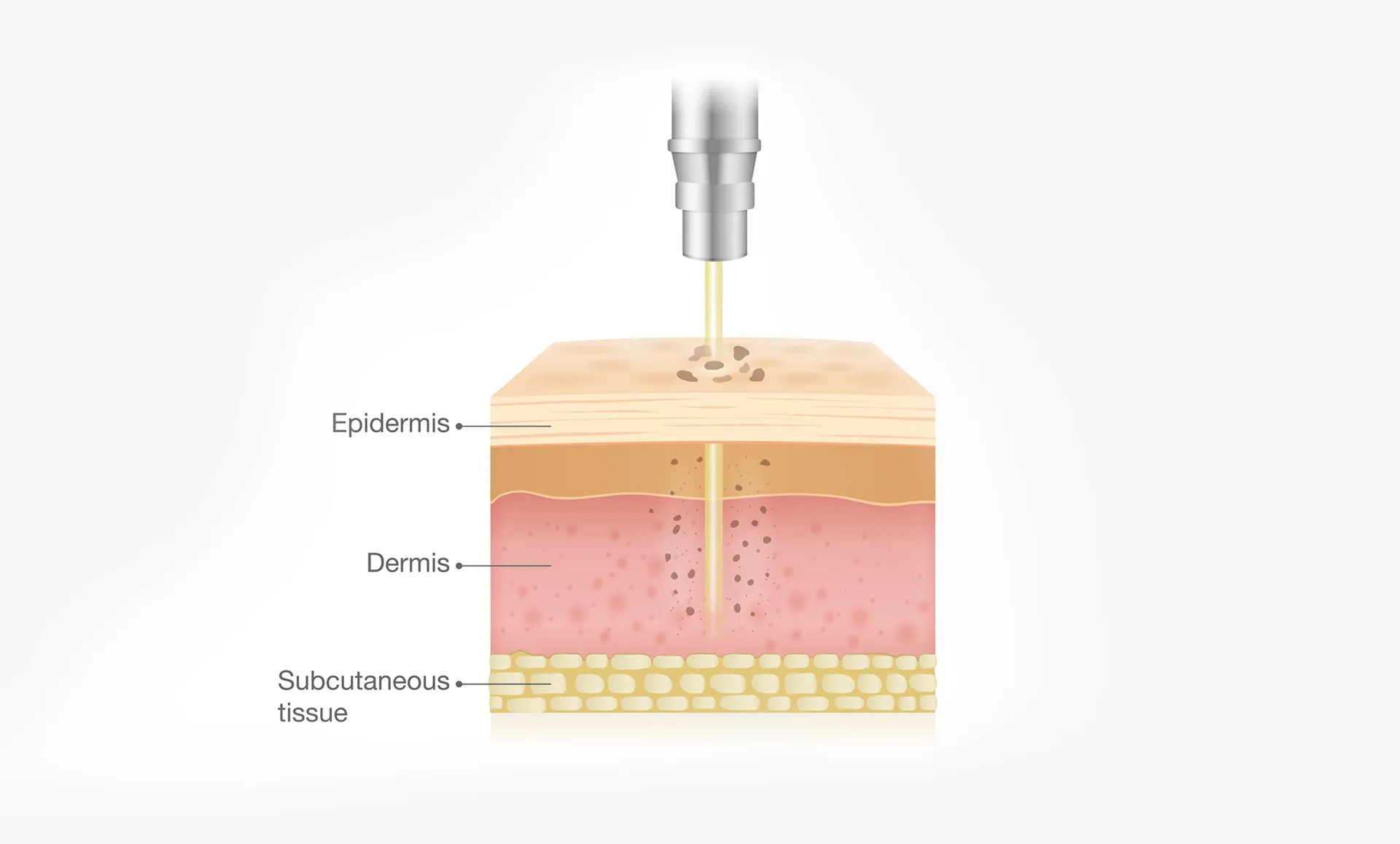
- “Fractional” refers to a treatment pattern, not a single laser device.
- Ablative resurfacing generally involves deeper correction and longer recovery.
- The fractional CO2 laser is commonly used for deeper acne scars and advanced texture concerns.
- RF microneedling and non-ablative lasers are often chosen for lower downtime.
- PIH risk remains an important consideration in Asian skin after resurfacing procedures.
- Recovery expectations are often just as important as the treatment itself.
Few areas of dermatology have developed as quickly or become as linguistically tangled as laser resurfacing.
Terms like fractional laser, CO2 laser, and non-ablative resurfacing are now used so frequently, and sometimes interchangeably, that the distinctions between them can start to blur.
Part of this comes from how much the technology itself has evolved. Treatments that sound closely related on paper can behave very differently once recovery, downtime, and clinical use enter the picture.
In this article, we’ll unpack where fractional CO2 lasers and non-ablative fractional lasers overlap, where they differ, and why those differences matter.
What "Fractional" Means (and Why the Word Confuses Patients)
What actually is a fractional laser? Here’s the definition dermatologists are referring to, and why the terminology becomes confusing so quickly.
The word “fractional” does not describe a specific laser machine. Instead, it describes how laser energy is delivered into the skin.
In a fractional laser treatment, the laser creates microscopic treatment zones separated by surrounding areas of untreated skin. Rather than resurfacing the entire skin surface evenly, the laser treats only fractions of the skin at a time.
Those untouched areas are important. Because portions of healthy skin remain intact between treatment zones, the skin is generally able to recover more efficiently after treatment compared to older fully ablative resurfacing methods.
Part of what makes the meaning of fractional laser difficult to understand is that different categories of laser treatments, including both ablative and non-ablative approaches, can use the same fractional delivery pattern.
Over time, the terminology gradually expanded to include treatments that may behave very differently in practice despite sounding closely related.
Ablative vs Non-Ablative Fractional Lasers
Once dermatologists begin discussing fractional resurfacing, the conversation usually branches into two broader categories: ablative and non-ablative treatments.
Both use fractional technology, but they affect the skin in very different ways.
An ablative laser works by removing microscopic columns of skin tissue during treatment. Erbium YAG and fractional CO2 lasers fall into this category.
Because these treatments remove portions of skin tissue during resurfacing, they are generally associated with more substantial textural correction and longer recovery.
Redness, swelling, peeling, and several days of social downtime are often expected after more aggressive ablative resurfacing procedures.
A non-ablative laser, by contrast, heats deeper skin layers while leaving most of the skin surface intact. Fractional erbium glass lasers are among the most commonly used examples.
Radiofrequency microneedling is not technically a laser, but it is often discussed alongside non-ablative resurfacing treatments because of its similar lower-downtime approach to dermal repair.
Recovery is typically milder with non-ablative laser treatments. Many patients experience temporary redness or mild swelling rather than extensive peeling or crusting. The trade-off is that improvement is often more gradual, with multiple sessions usually needed to achieve more substantial results.
This remains one of the defining tensions in modern fractional resurfacing: treatments associated with deeper correction often involve more visible downtime, while lower-intensity approaches tend to improve more gradually over time.
Book a consultation with a dermatologist at DermAlly to discuss which resurfacing approach best fits your skin type, lifestyle, and recovery expectations.
Fractional CO2 Laser: Mechanism, Indications, Trade-offs
Among the many treatments that now fall under the umbrella of fractional resurfacing, the fractional CO2 laser remains one of the most aggressive.
It uses a 10,600nm wavelength that is strongly absorbed by water within the skin. Because skin contains large amounts of water, the laser canis able to create microscopic zones of vaporised tissue during treatment while triggering a broader wound-healing response underneath.
That mechanism is what gives fractional CO2 laser resurfacing its reputation for deeper textural correction. It is also what makes the recovery process more noticeable compared to lower-intensity resurfacing approaches.
For deeper atrophic acne scars, more advanced photoageing, and established textural changes, gentler resurfacing treatments may not always create enough remodelling to produce meaningful improvement. In such cases, fractional CO2 laser treatment may sometimes be considered when deeper resurfacing is the priority.
Treatment plans typically involve between one and three sessions, depending on the condition being treated, skin response, and treatment intensity. While fewer sessions are often needed compared to lower-intensity resurfacing approaches, each treatment is generally more intensive and associated with longer recovery.
The downtime, however, is difficult to ignore.
Most patients should expect visible redness, peeling, swelling, skin sensitivity, and social downtime lasting roughly five to 10 days after treatment. Even once the initial healing phase settles, residual redness can sometimes persist longer.
For Fitzpatrick skin types III to VIII to V skin types, which represent much of the Singaporean population, post-inflammatory hyperpigmentation (PIH) remains one of the most important risks to discuss before treatment. In clinical practice, dermatologists often adjust treatment density, settings, and pre- and post-treatment skincare protocols carefully to reduce the likelihood of prolonged pigmentation changes after a CO2 laser procedure in Singapore.
Sun protection also becomes particularly important during recovery. Newly treated skin is more vulnerable to ultraviolet exposure while healing, especially after ablative resurfacing procedures such as fractional CO2 laser treatment for deeper acne scars.
Non-Ablative Fractional Options
Not every patient wants, or needs, the level of resurfacing associated with an ablative procedure.
In many cases, dermatologists instead consider treatments that focus more on gradual dermal renewal while keeping disruption to the skin surface relatively limited.
One of the most commonly discussed options in Singapore is RF microneedling. Unlike traditional lasers, these devices use insulated needles to deliver radiofrequency energy directly into the dermis beneath the skin surface.
Various “gold” RF microneedling systems have become particularly popular locally because they allow heat to be delivered at controlled depths while limiting unnecessary surface injury.
Another category includes non-ablative fractional laser systems, such as 1550nm and 1565nm erbium glass lasers. These treatments create controlled zones of thermal injury beneath the skin while leaving most of the skin surface intact.
The appeal of these approaches is often practical as much as clinical.
For many patients, the shorter recovery period alone can make these approaches feel considerably more manageable.
The trade-off is that improvement tends to unfold more gradually. Multiple treatment sessions are commonly needed, particularly when treating longstanding textural concerns or acne scarring.
What Fractional Approach Suits Each Skin Concern
What Fractional Approach Suits Each Skin Concern
The question is rarely whether fractional resurfacing works. It is usually the version that makes sense for the problem being treated.
Acne Scars
Fractional CO2 laser for deeper atrophic acne scars may be considered when patients are comfortable with a longer recovery period.
Mixed or rolling acne scars are often approached differently in Asian skin. In these situations, RF microneedling is commonly used because it allows collagen remodelling with less surface disruption.
Pigmentation risk also influences treatment selection. In Fitzpatrick III to V skin types, non-ablative resurfacing approaches are often considered safer when post-inflammatory hyperpigmentation is a major concern alongside acne scarring.
Wrinkles and Texture
Fractional CO2 laser for wrinkles and more advanced textural ageing may sometimes be used when more substantial remodelling is needed.
Fine lines and milder texture irregularities are often approached more conservatively using non-ablative resurfacing treatments.
Stretch Marks
Stretch marks are often approached using collagen-stimulating treatments because the structural changes develop deeper within the dermis.
Microneedling may sometimes be used for milder stretch marks or gradual texture improvement over time.
Radiofrequency treatment is also commonly used because it delivers controlled heat into deeper skin layers to stimulate collagen remodelling beneath the skin surface.
For more established stretch marks and bigger textural changes, fractional CO2 laser treatment may sometimes be considered when patients are comfortable with a more intensive recovery process.
Pigmentation
Fractional resurfacing is generally not considered the primary treatment approach for pigmentation alone.
For concerns such as lentigines, post-inflammatory pigmentation, or vascular-related discolouration, pico laser or yellow laser treatments are often considered first-line options depending on the underlying cause.
Recovery and Downtime Comparison
| Treatment | Typical Recovery Profile | Common Downtime Expectations |
| Fractional CO2 Laser | More intensive resurfacing with visible peeling, redness, swelling, and post-procedure skincare requirements | Roughly five to 10 days of noticeable social downtime |
| RF Microneedling | Mild redness and swelling with relatively limited disruption to the skin surface | Usually around one to three days |
| Fractional Non-Ablative Laser | Temporary redness and mild skin sensitivity without extensive peeling | Usually around one to three days |
Recovery timelines can still vary depending on treatment intensity, skin sensitivity, and how aggressively the skin is treated during each session.
Risks and Side Effects
All resurfacing procedures involve some degree of controlled skin injury, which means side effects and complications remain important to discuss before treatment.
For Asian skin types, PIH is one of the most significant considerations after laser resurfacing. In Fitzpatrick III to V skin, inflammation during healing can sometimes trigger prolonged darkening of the treated areas, particularly after more aggressive resurfacing procedures.
Prolonged redness, also known as persistent erythema, may occasionally occur as well, especially after ablative treatments.
Scarring, infection, and hypopigmentation are considered uncommon when resurfacing is performed with appropriate parameters, but they remain recognised risks.
Because of this, dermatologists often place significant emphasis on pre- and post-treatment care. Depending on the patient and treatment type, this may include temporary retinoid cessation, structured topical skincare regimens, strict sun avoidance, and careful photoprotection throughout the recovery period.
Skin Type Considerations for Asian Skin
Most patients in Singapore fall within Fitzpatrick III to V skin types, which is one reason resurfacing treatments are often approached differently here compared to Western laser protocols.
In darker skin tones, inflammation after treatment is more likely to trigger PIH. This means the risk profile for fractional laser procedures in Asian skin can differ quite substantially from what many patients encounter in overseas videos or international before-and-after discussions online.
This does not mean resurfacing treatments cannot be performed safely in Asian skin. It means treatment settings usually need to be adjusted more carefully.
In clinical practice, dermatologists may modify treatment density, energy levels, session spacing, and post-treatment skincare protocols depending on the patient’s pigmentation risk and healing response. Pre-treatment skin preparation, temporary retinoid cessation, and strict sun protection are often discussed as part of reducing the likelihood of PIH complications post-fractional laser.
This is also why “global” laser advice can sometimes become misleading. A resurfacing protocol designed for lighter Fitzpatrick I or II skin may not translate safely or predictably to laser Asian skin concerns commonly seen in Singapore clinics.
For many patients considering a fractional laser treatment in Singapore, the discussion is therefore not simply about how aggressive a treatment can be, but how safely the skin can recover afterwards.
How DermAlly Decides Between Options
At DermAlly, resurfacing treatments are typically selected based on the underlying skin condition, pigmentation risk, downtime tolerance, and treatment goals rather than a single “best laser” approach.
During consultation, our dermatologists assess factors such as scar morphology, skin sensitivity, active inflammation, textural depth, and Fitzpatrick skin type before deciding whether ablative or non-ablative resurfacing is more appropriate.
For some patients, a more intensive resurfacing approach may be reasonable. For others, especially patients with higher pigmentation risk or ongoing inflammation, more conservative collagen-remodelling strategies may be preferred initially.
This process is also why different patients with superficially similar concerns may receive very different treatment recommendations in practice.
Book a consultation at DermAlly to determine which resurfacing approach is most appropriate for your skin type, pigmentation risk, and treatment goals.
Frequently Asked Questions About Fractional Laser in Singapore
What's the difference between fractional CO2 laser and RF microneedling?
Fractional CO2 laser is generally more intensive and involves longer downtime, while RF microneedling is usually associated with shorter recovery and more gradual improvement.
Fractional CO2 resurfacing removes microscopic columns of skin tissue during treatment. RF microneedling delivers radiofrequency heat beneath the skin surface through insulated needles while leaving most of the surface skin intact.
How long is the downtime for a fractional CO2 laser?
Most patients experience around five to 10 days of visible redness, peeling, and social downtime after fractional CO2 laser treatment.
Residual redness can sometimes last longer depending on treatment intensity and skin sensitivity.
Is fractional laser safe for darker skin types?
Yes, fractional laser treatments can be used in darker skin types, but the post-inflammatory hyperpigmentation (PIH) risk is generally higher in Fitzpatrick III to V skin.
Because of this, dermatologists often adjust treatment settings and recommend careful sun protection and post-treatment skincare.
How many sessions of fractional laser do I need?
The number of sessions depends on the condition being treated and the type of resurfacing used.
More intensive treatments, such as fractional CO2 laser, may involve fewer sessions, while non-ablative approaches often require multiple treatments over time.
Can I combine fractional laser with other treatments?
Yes. Fractional laser treatments are often combined with other procedures or medical skincare, depending on the skin concern being treated.
This may include RF microneedling, pigment-focused lasers, or topical treatments.
Will a fractional laser remove my acne scars completely?
No. Fractional laser treatment may improve acne scar texture significantly, but complete scar removal is generally not realistic. The goal is usually meaningful improvement rather than total erasure.
Key Takeaway
- More aggressive resurfacing is not automatically the better treatment choice.
- Recovery expectations often shape treatment decisions as much as clinical severity.
- RF microneedling is commonly used in Asian skin because of its lower PIH risk profile.
- Fractional resurfacing is usually selected based on the specific skin concern being treated.
- Safe laser treatment in Singapore often depends on careful parameter adjustment and aftercare.
Start with a Professional Skin Assessment
Deeper resurfacing is not always the better option, especially in Asian skin where recovery and pigmentation risk require careful consideration.
Book a consultation at DermAlly to determine which resurfacing approach best aligns with your skin condition and downtime tolerance.


Our articles are written and reviewed by Dr. Coni Liu (MRCS, FAMS), Dr. Heng Jun Khee (MRCP, FAMS), and Dr. Cheng Hui Mei (FAMS), Ministry of Health-accredited Consultant Dermatologists at DermAlly.
All three are Fellows of the Academy of Medicine (Dermatology) and previously served as Consultants at the National Skin Centre (NSC), bringing extensive experience in medical, surgical, and aesthetic dermatology. They are committed to making expert-led skin education accessible, practical, and clear, helping patients look and feel their best through evidence-based care rooted in science and compassion.