Skin tags are small growths that typically form where skin folds. While harmless, they can become bothersome when they catch on clothing or jewellery, or become more visible.
At DermAlly, our dermatologists remove skin tags with your comfort and skin health in mind. Depending on the size and location of the tags, removal may involve laser treatment, electrosurgery, or minor excision.
Not sure if it’s a skin tag or another type of growth? Let us examine it and advise you on the next step.
Reviewed By:
Skin tags, medically known as acrochordons, are soft, benign growths that hang from the skin by a narrow stalk. Because of their appearance, they’re sometimes mistaken for warts or moles, both of which require different evaluation and treatment.
Applying the wrong treatment can irritate the skin, cause unnecessary discomfort, or lead to scarring. Worse, mistaking a more serious lesion for a skin tag could delay appropriate medical care. This is why getting the right diagnosis is essential before proceeding with any removal procedure.

Skin tags are caused primarily by friction, when skin repeatedly rubs against skin or clothing, triggering excess growth of normal skin tissue. However, friction alone doesn’t explain why some people develop skin tags more readily than others.
Several other factors may increase your risk:

Skin tags are more common in adults over 40, likely due to changes in skin elasticity and long-term exposure to friction.

Carrying extra weight creates more skin folds, which increases skin-to-skin rubbing.

Shifts in hormone levels, especially during pregnancy, can affect how the skin grows and responds to friction.

If close family members have skin tags, you may be more likely to develop them as well.

Both conditions are associated with metabolic changes that may make skin tags more likely to form.
Skin tags don’t usually cause symptoms and are often discovered by chance — a small bump that wasn’t there before. They’re soft, flesh-coloured, and mostly painless, though they can become tender or irritated.
In some cases, a tag may twist at its base, cutting off blood flow and causing it to darken or fall off on its own. Others may bleed slightly if accidentally pulled or scratched.
Skin tags tend to appear where friction is common, such as the:
Some stay tiny, like a grain of rice, while others grow larger or become more noticeable over time.
Although a skin tag is generally not a cause for concern, any changes in colour, shape, or texture should be checked by a dermatologist to rule out other skin conditions.
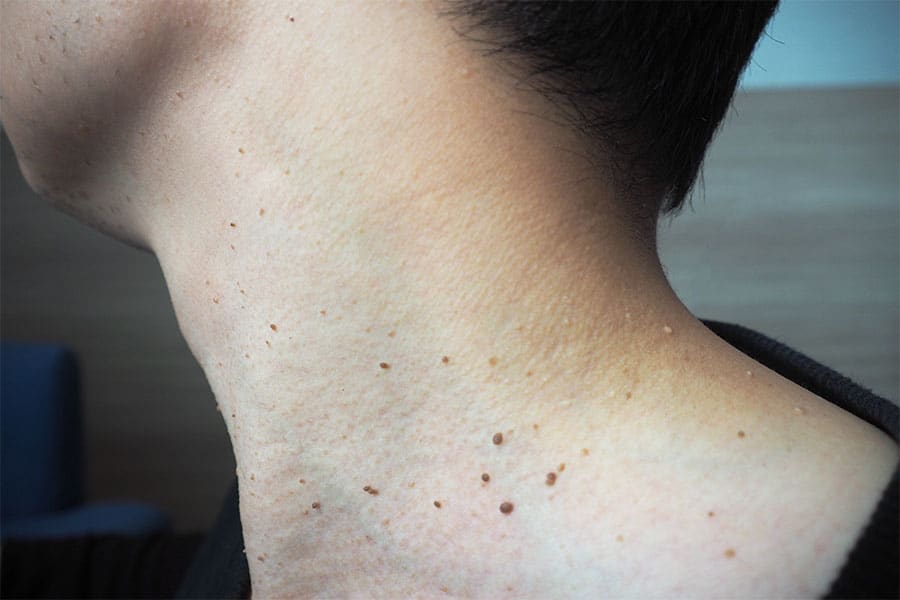
There’s no medical urgency for you to remove a skin tag. But over time, small inconveniences can add up — enough to make removal worth considering.
Tired of bothersome skin tags? DermAlly offers effective skin tag removal in Singapore, performed by experienced dermatologists. We prioritise your comfort and safety. Book an assessment to discuss your options.
When performed by a dermatologist, skin tag removal is a low-risk procedure. Still, you may experience some side effects as your skin recovers, including:
These are part of the normal healing process and typically improve on their own.
Trying to remove a skin tag yourself at home carries far more risk. It can cause bleeding, infection, or unnecessary scarring. And without a proper diagnosis, you may be treating something that isn’t actually a skin tag.
After a consultation and confirmation that the growth is a skin tag, your dermatologist will recommend the most suitable removal method. At DermAlly, that will depend on how large the tag is, where it’s located, and whether there’s more than one to remove.
Treatment | Recommended For | Benefits | Possible Side Effects |
Snip Excision | Larger or stalk-like (pedunculated) skin tags | – Immediate removal – Quick procedure – Tissue can be sent for lab testing if required | – Minor bleeding – Small mark or mild redness during healing |
Electrosurgery (Cautery) | Multiple or smaller skin tags | – Minimal bleeding – Controlled removal – Low chance of recurrence | Temporary redness or scabbing |
Laser Skin Tag Removal | Facial or sensitive areas, such as the eyelids or neck | – Minimal scarring – Short recovery time – Suitable for delicate skin | Mild redness or temporary darkening (hyperpigmentation) |
Cryotherapy (Freezing) | Very small or superficial skin tags | – Non-invasive – No cutting required | – Mild blistering – Temporary colour change |
Here’s what each procedure involves:
A skin tag excision involves trimming the tag at its base after applying local anaesthesia to numb the area. The procedure takes only a few minutes, and any bleeding is quickly controlled.
An electrosurgery to remove a skin tag uses electric currents to heat and remove the skin tag while sealing small blood vessels at the same time. This helps reduce bleeding and encourages clean healing.
A focused laser beam removes the skin tag, leaving the surrounding skin untouched. Because it doesn’t involve cutting, it’s recommended for highly visible areas.
Cryotherapy uses liquid nitrogen to freeze and destroy the tissue, causing the tag to dry up and fall off naturally. Though less common in Singapore, it remains an option for small surface tags.
The downtime after a skin tag removal is usually very short. Most people go back to their normal activities the same day, with just a small area of skin to care for afterwards.
How quickly the skin heals varies from person to person, and depends on the method your dermatologist used to remove the tag:
You can also follow these aftercare tips as you recover from a skin tag removal:
The cost of a skin tag removal in Singapore differs depending on how the procedure is performed.
Removal Method | Estimated Cost (SGD) |
Snip Excision | $100 – $300 per tag |
Electrosurgery (Cautery) | $80 – $200 per session |
Laser Skin Tag Removal | $150 – $500 per tag or session |
Cryotherapy (Freezing) | $50 – $150 per session |
Other factors that influence cost include:
Contact us to discuss your case and receive a cost estimate based on the treatment that’s most appropriate for you.
In Singapore, skin tag removals should always be performed in a clinic licensed by the Ministry of Health (MOH) and supervised by dermatologists registered with the Singapore Medical Council (SMC). This ensures that each procedure is medically appropriate and carried out under proper clinical standards.
At DermAlly, our dermatologists offer both laser and minor surgical options so treatment can be tailored to your needs. Every step — from assessment to aftercare — is managed with care and attention to your comfort.
You may also notice that we don’t share before-and-after photos online. The MOH does not allow medical clinics in Singapore to publish treatment result images on websites or social media. These can only be shown privately during your consultation.
If you’re thinking about having a skin tag removed, speak with our dermatologists at DermAlly for a proper diagnosis and advice on the treatment best suited to you.

Consultant Dermatologist
Dr Liu specialises in general dermatology, dermatologic surgery, aesthetic dermatology, and women’s dermatology. She previously practised at the National Skin Centre, where she also oversaw the women’s clinic, and has taught future doctors at NUS and Lee Kong Chian School of Medicine.

Dermatologist
Dr Heng has special interests in eczema, skin cancers, dermatologic surgery, cosmetic dermatology, and lasers. She was part of the dermatologic surgery and laser team at the National Skin Centre, and continues as a Visiting Consultant. She has also taught at NUS, Duke-NUS, and NTU’s Lee Kong Chian School of Medicine.
You don’t need to live with the irritation or distraction of a skin tag. A short consultation is all it takes to confirm what it is and discuss removal options that fit your skin and schedule.
At DermAlly, our dermatologists handle the full process, often within the same visit. Removal is quick, medically guided, and done with your comfort in mind.
Most people describe the procedure as quick and tolerable. A numbing cream or local anaesthetic is applied before removal, so you shouldn’t feel pain. Afterwards, the area may feel slightly tender for a day or two.
Once a skin tag is completely removed, it doesn’t grow back in the same spot. However, new tags may form in other areas. Your dermatologist can advise on how to reduce recurrence.
It’s not recommended. Cutting off a tag on your own can lead to bleeding, infection, or scarring.
Most skin tag removal areas heal within five to 10 days after laser or electrosurgery, and about one to two weeks after excision. Any redness or small scab fades gradually during this time.
Skin tags are soft, flesh-coloured growths that hang loosely from the skin. Warts, on the other hand, are caused by the human papillomavirus (HPV) and tend to have a rough surface. They can also spread through contact, unlike skin tags, which are not contagious.
Because skin tags are benign and considered a cosmetic concern, removal is generally not covered by insurance or MediSave. If your dermatologist suspects the growth could be another type of lesion that requires biopsy, medical coverage may apply.
Book an appointment with our expert dermatologists. Please select your preferred clinic below.
